
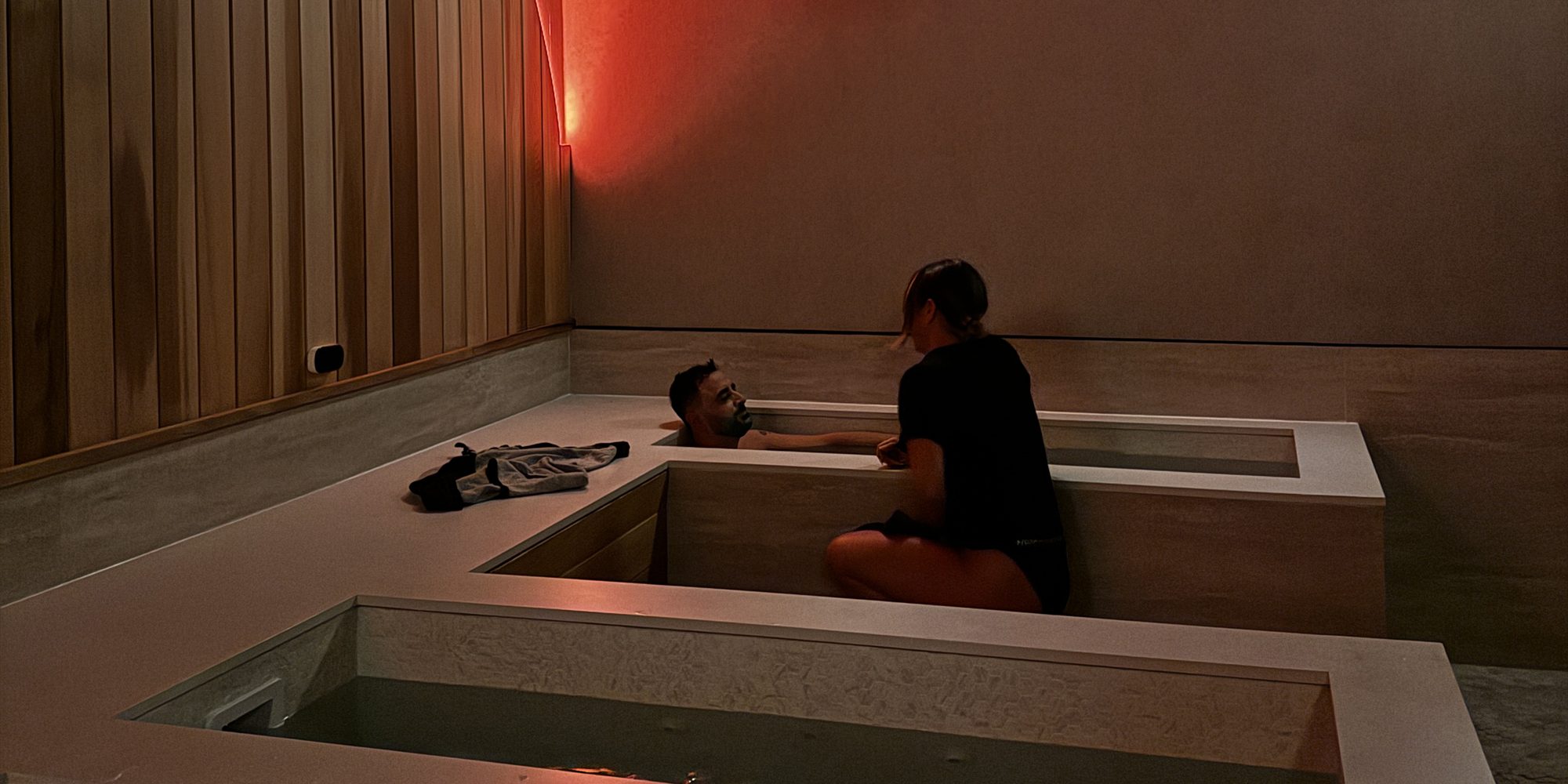
Red light therapy has gone from dermatology clinics to gyms, spas and home panels in just a few years. With that growth has come a lot of big promises. This guide sticks to what published research actually reports, what it does not, and how red light therapy at Club Sūdō in Vaughan fits into a recovery routine alongside sauna, cold plunge and Reformer Pilates.
The short version: research suggests red light therapy may support collagen production and skin texture, and it may help reduce muscle soreness in the days after hard training. Evidence for joint comfort is more limited. None of it replaces medical care.
How Red Light Therapy Works
Red light therapy exposes the skin to specific wavelengths of red light and near-infrared light, usually from an LED panel. Researchers often call this photobiomodulation. Red light sits at the long end of the visible spectrum. Near-infrared light has longer wavelengths than the eye can see; infrared is generally defined as starting around 700 to 750 nm, just past visible red.
A Cleveland Clinic dermatologist, Dr. Jennifer Lucas, describes red light therapy as using red or near-infrared light to promote cellular growth, decrease inflammation and support the production of collagen. Researchers studying muscle soreness have proposed that this kind of light may activate signalling pathways inside cells and improve microcirculation. These are proposed mechanisms, and scientists are still working out the details.
Two things red light therapy is not: it is not ultraviolet light, so it is not a tanning method, and it is not a sauna. The panel delivers particular wavelengths of light rather than heating the air around you.
At Club Sūdō, red light therapy uses a Coldture PRO full-body panel. According to the manufacturer, it has 720 LEDs across eight wavelengths: 630, 650, 660 and 670 nm in the red range, 810, 830 and 850 nm in the near-infrared range, and 1060 nm.
Skin and Collagen
Skin is where the evidence is strongest. In a prospective, randomized, controlled trial of 136 volunteers published in 2014, people who received red and near-infrared light sessions showed significant improvements in skin complexion and skin feel, measured skin roughness and ultrasound-measured collagen density compared with controls. Blinded evaluators comparing photographs taken at the start and after 30 sessions also rated fine lines and wrinkles as improved.
One detail worth knowing: the study's principal investigator was paid by the study sponsor, which the paper discloses. That does not make the results wrong, but it is a reason to read them as promising rather than final. Dr. Lucas makes a similar point in plainer terms: when done consistently, research suggests red light may help with things like wrinkles and redness.
For a closer look at timelines and what to expect, read our guide to red light therapy for skin and collagen.
Muscle Recovery and Soreness
Delayed onset muscle soreness, the stiffness that peaks a day or two after a tough workout, is one of the most studied uses. A 2025 systematic review and meta-analysis found 14 studies on light therapy for this kind of soreness, using wavelengths from 660 to 950 nm. Four of them had enough data to pool.
In that pooled analysis, muscle strength recovered better at 24 and 48 hours after the soreness-inducing exercise, and pain scores were lower at 72 and 96 hours. Some studies also reported lower blood markers of muscle damage. The authors call the findings promising but note that relatively few high-quality trials exist and that more research is needed. Most studies aimed lasers or LEDs at specific points on the muscle rather than using full-body panels.
So the honest claim is that red light therapy may help reduce muscle soreness in the days after hard training. Our article on red light therapy for muscle recovery goes deeper, including where results are mixed.
Joint Pain
Joint comfort has the thinnest evidence of the three. A 2022 systematic review of 13 studies on infrared therapies reported lower pain scores in people with musculoskeletal conditions, including three studies on osteoarthritis. That review covers infrared broadly, including far-infrared fabrics, patches and saunas as well as light therapy, so it does not tell us much about red light panels specifically. Results for low back pain were mixed.
The fair summary is that some research on infrared therapies reports less joint and muscle pain. If you live with arthritis or a diagnosed joint condition, speak with your physician or physiotherapist first. Our guide to red light therapy for joint pain covers this in more detail.
What the Evidence Does Not Support Yet
It is just as useful to know where research falls short:
- Faster return from injury. A 2024 meta-analysis of six randomized trials in 205 athletes found that light therapy reduced pain compared with control groups, but the two trials that measured return to play found no benefit. The authors conclude that limited evidence suggests it does not shorten time away after an injury.
- Muscle recovery after athletic injuries. The 2022 infrared review found that infrared therapies did not help muscle recovery following athletic injuries.
- Dramatic or permanent change. The skin research measured gradual change over many sessions. No good evidence supports overnight results or claims that light therapy stops ageing.
- Replacing medical care. Red light therapy is a wellness practice, not a medical procedure. It is not a substitute for diagnosis or care from a health professional.
Safety and Who Should Avoid It
Red light therapy is generally well tolerated, but it is not for everyone. Dr. Lucas advises that anyone with a photosensitive disorder, meaning sun exposure causes blisters or burns, should avoid red light therapy. The same goes for people taking medications that make them sensitive to the sun, such as certain antibiotics and blood pressure medications. She recommends talking to a dermatologist before starting.
Anyone with a medical condition should speak with their healthcare provider first. Because red light at Club Sūdō is part of a contrast therapy session, the studio's contrast therapy guidance also applies: check with your doctor first if you are pregnant, have a cardiovascular condition or have been advised to avoid temperature extremes.
Red Light Therapy in Vaughan
At Club Sūdō, red light therapy is part of the contrast therapy experience, alongside our traditional dry-heat sauna, our cold plunge kept at around 3 to 7°C and a lounge to unwind in afterward. You can choose a Guided session, where an instructor leads breathwork and timed heat and cold, or an Open Flow session at your own pace. New to the hot and cold side of things? Start with what contrast therapy is and what to expect.
Many members pair it with Reformer Pilates: train on the reformer, then recover. We are at 16 Famous Ave, Unit 145, in Vaughan (Woodbridge), open Monday to Friday 6am to 10pm, Saturday 7am to 8pm and Sunday 8am to 8pm. Book a contrast therapy session or explore passes and memberships.
Sources
- Wunsch A, Matuschka K. A controlled trial to determine the efficacy of red and near-infrared light treatment in patient satisfaction, reduction of fine lines, wrinkles, skin roughness, and intradermal collagen density increase. Photomedicine and Laser Surgery. 2014;32(2):93-100. https://pubmed.ncbi.nlm.nih.gov/24286286/
- Cleveland Clinic Newsroom. Can Red Light Therapy Improve Your Skin and Hair? September 2, 2026. https://newsroom.clevelandclinic.org/2026/09/02/can-red-light-therapy-improve-your-skin-and-hair
- Tsou YA, Chang NJ, Chang WD. Effects of photomodulation therapy for delayed onset muscle soreness: a systematic review and meta-analysis. Journal of Functional Morphology and Kinesiology. 2025;10(3):277. https://www.mdpi.com/2411-5142/10/3/277
- Morgan RM, Wheeler TD, Poolman MA, Haugen ENJ, LeMire SD, Fitzgerald JS. Effects of photobiomodulation on pain and return to play of injured athletes: a systematic review and meta-analysis. Journal of Strength and Conditioning Research. 2024;38(6):e310-e319. https://doi.org/10.1519/JSC.0000000000004752
- Tsagkaris C, Papazoglou AS, Eleftheriades A, Tsakopoulos S, Alexiou A, Găman MA, Moysidis DV. Infrared radiation in the management of musculoskeletal conditions and chronic pain: a systematic review. European Journal of Investigation in Health, Psychology and Education. 2022;12(3):334-343. https://www.mdpi.com/2254-9625/12/3/24